
Education and Visualizaton of Chemical Phenomena
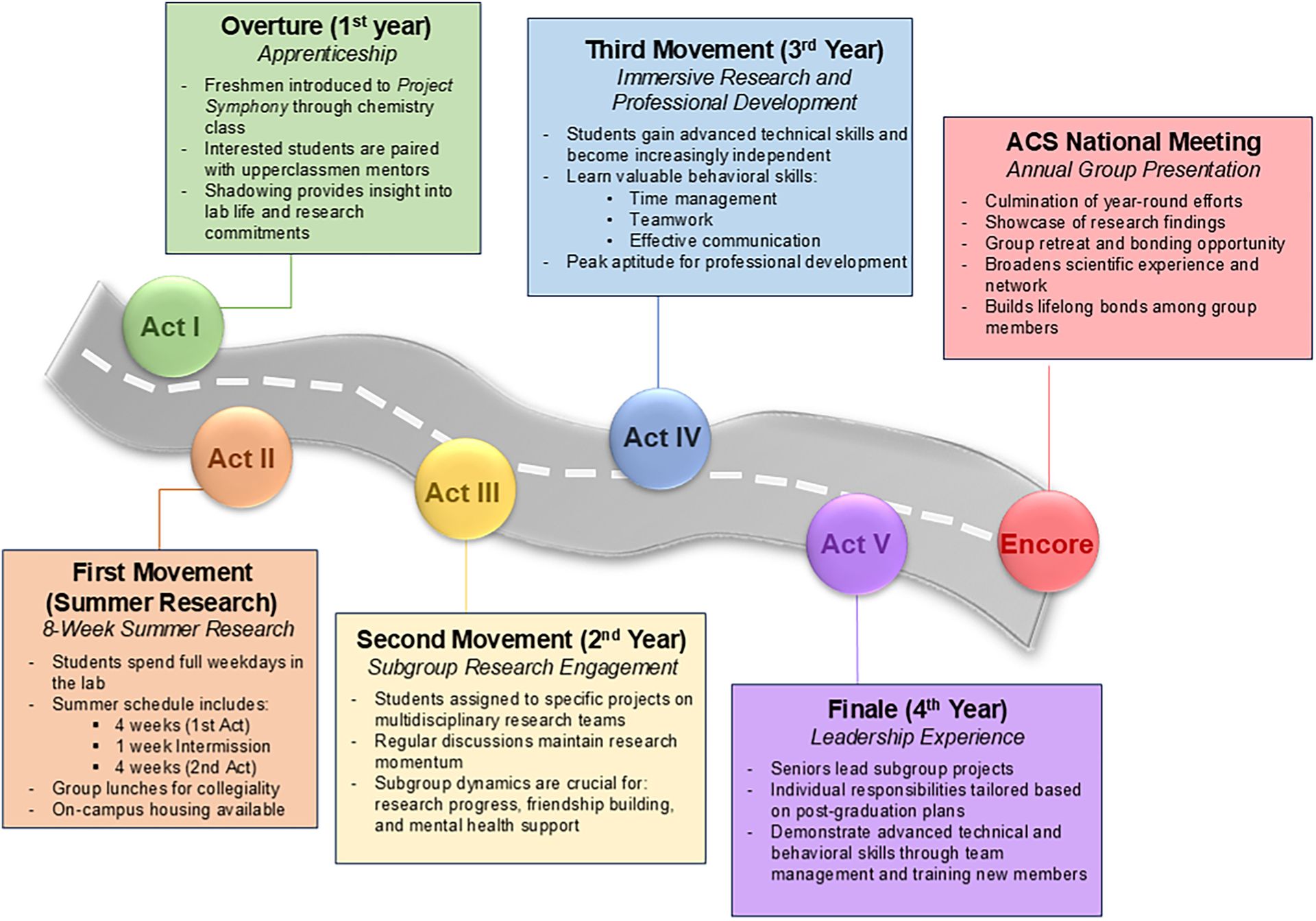
Key notes of the Project Symphony
pedagogical framework
At a Predominantly Undergraduate Institution (PUI) like Iona University, Sunghee Lee, Ph.D., has built her academic career around integrating teaching and research in an interdisciplinary environment. As a Professor of Chemistry, she views the undergraduate classroom and the research laboratory as connected spaces where students move between fundamental concepts and real scientific practice. Her goal is to use research as a bridge linking classroom theory to real-world, interdisciplinary scientific work.
Within Project Symphony, students and recent graduates engage in collaborative research experiences that develop technical skills, independence, teamwork, and scientific communication. Their “backstory” reflects how participation in the group has shaped their journeys, illustrating the transformative impact of sustained undergraduate research and mentoring. The symphony they create together continues to evolve as new students join, contribute, and grow.
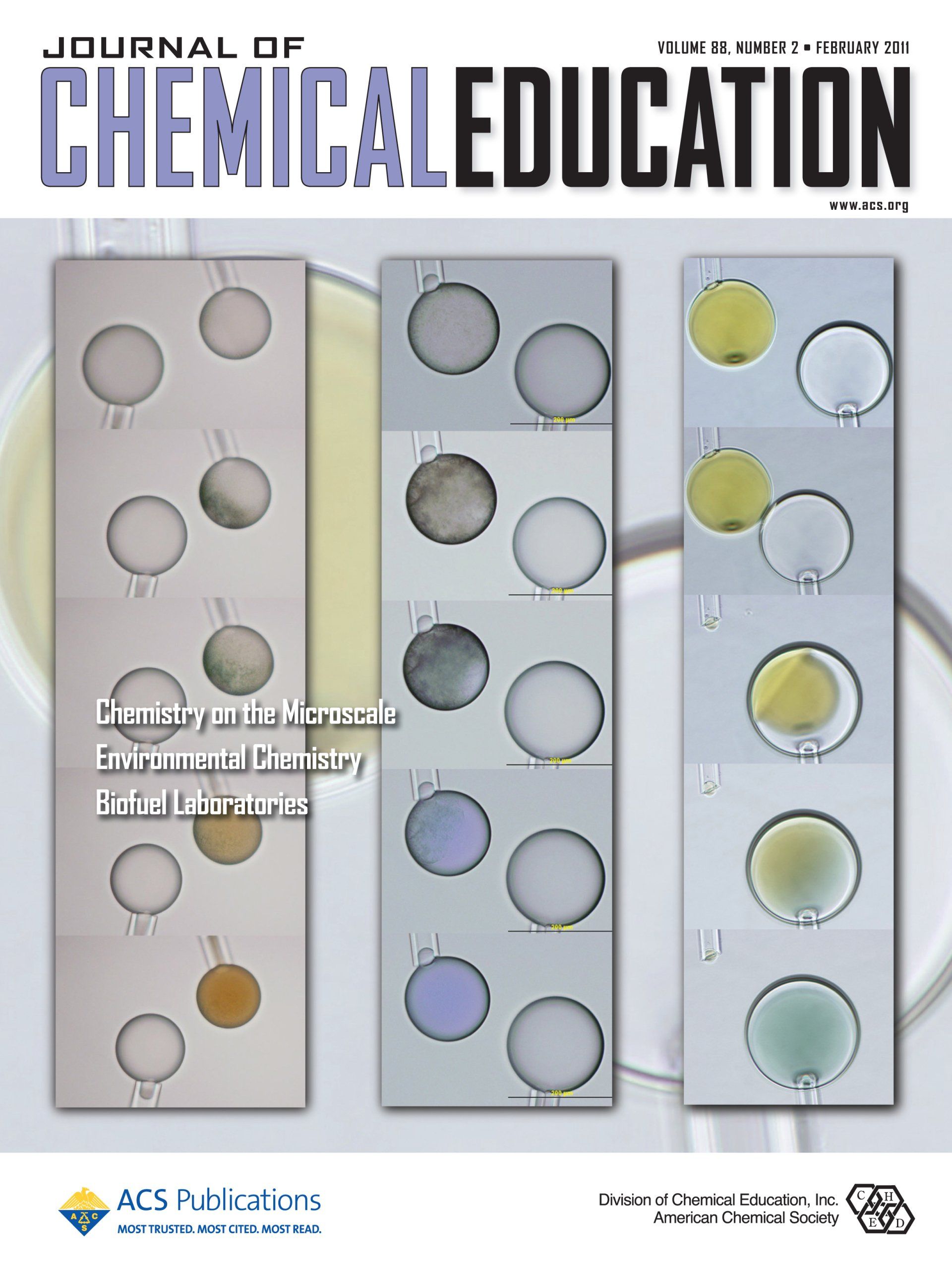
Visualizing chemistry in microdroplets
A central theme of this educational work is the visualization of chemical and physical phenomena, especially in systems where scale and interfaces play a critical role. Micrometer-sized droplets exhibit unique properties that arise from their small size and large surface area-to-volume ratio, yet students are often unfamiliar with how chemistry changes at these dimensions. As miniaturization and microdroplet microfluidics become increasingly important in chemistry and biochemistry, it is essential for students to appreciate how “small-scale chemistry” differs from bulk behavior.
To support this understanding, Prof. Lee’s group has developed microdroplet systems that model microfluidics in a “stop‑action” format for teaching and outreach. Using a micropipette manipulation technique combined with video microscopy, students visualize chemical reactions and physical phenomena occurring in one or more individual water droplets surrounded by an immiscible liquid. These experiments highlight outcomes of redox reactions, precipitation, interfacial extraction of metals, solubility of water in oils, and crystallization, all framed as dramatic demonstrations of how a large surface area-to-volume ratio reshapes chemical behavior.
Selected publications. For more details, please see our publications (undergraduate co-authors are underlined):
- Lee, S., Gudyka, J., Skinner, M., Ceja-Vega, J., Rabadi, A., Poust, C., Scott, C., Panella, M., Andersen, E. and Said, J., Project symphony: Composing a masterpiece in a science laboratory, iScience 28, no. 2 (2025). https://www.sciencedirect.com/science/article/pii/S2589004225001464
- Giancaspro J,
Scollan P,
Rosario J,
Miller E,
Braziel S, Lee S. Structural determination of model phospholipid membranes by Raman spectroscopy: Laboratory experiment.
Biochem Mol Biol Educ.
2022; 1–12.
https://doi.org/10.1002/bmb.21603
- S. Lee, J. Wiener, Visualizing Chemical Phenomena in Microdroplets, J. Chem. Educ., 88 (2), 151-157, 2011. (Featured as Cover Art, Feb. 2011 Issue of J. Chem. Educ.) http://pubs.acs.org/doi/abs/10.1021/ed100518k
- Sunghee Lee, Building Strong Bonds: Chem. Club in the Classroom. The Chemical Educator, 14, 146-149, 2009. http://chemeducator.org/bibs/0014003/14090145sl.htm
- Sunghee Lee, Jerome S. Levkov, Motivating Students Through Career Exploration: Career Information in Science at Iona College (“CSI”). The Chemical Educator, 14, 41-44, 2009. http://chemeducator.org/bibs/0014001/14090041sl.htm