
Welcome to Project Symphony Membrane Biophysical Chemistry Research Group
Project Symphony reflects our belief that meaningful scientific progress comes from researchers working together in harmony toward shared goals. Our research seeks to advance fundamental understanding of cell membranes and to elucidate how bioactive molecules interact with, influence, and modulate membrane structure and function. We pursue these questions at the interface of chemistry, biology, physics, and medicine in a highly dynamic and collaborative interdisciplinary environment. We welcome team members who are driven by curiosity, innovation, excellence, persistence, and a strong commitment to teamwork.
Our laboratory uses approaches from surface chemistry, membrane biophysics, and related analytical methods to investigate these questions through the following active research programs:
- Membrane-mimicking systems: Our group builds artificial mimics of cell membranes to deepen our fundamental understanding of membrane structure, dynamics, and function. Using water droplets immersed in lipid-containing oil, we create droplet interface bilayers and related lipid assemblies as versatile platforms for probing membrane biophysical chemistry.
- Drug–membrane and bioactive molecule–membrane interactions: We use techniques including confocal Raman spectroscopy, ATR-FTIR spectroscopy, differential scanning calorimetry, electrophysiology, and tensiometry to study the detailed molecular structure of lipid membranes and how it changes upon interaction with bioactive molecules such as drugs, cholesterol, proteins, and nanomaterials.
- Crystal and interfacial assembly: We also investigate how molecules self-assemble at soft water–oil interfaces to control the structure of functional materials and crystals. By understanding these interfacial processes, we aim to inform the design of systems relevant to the pharmaceutical, cosmetic, and food industries.
Several of our studies take place in collaboration with other laboratories in Japan and Italy.



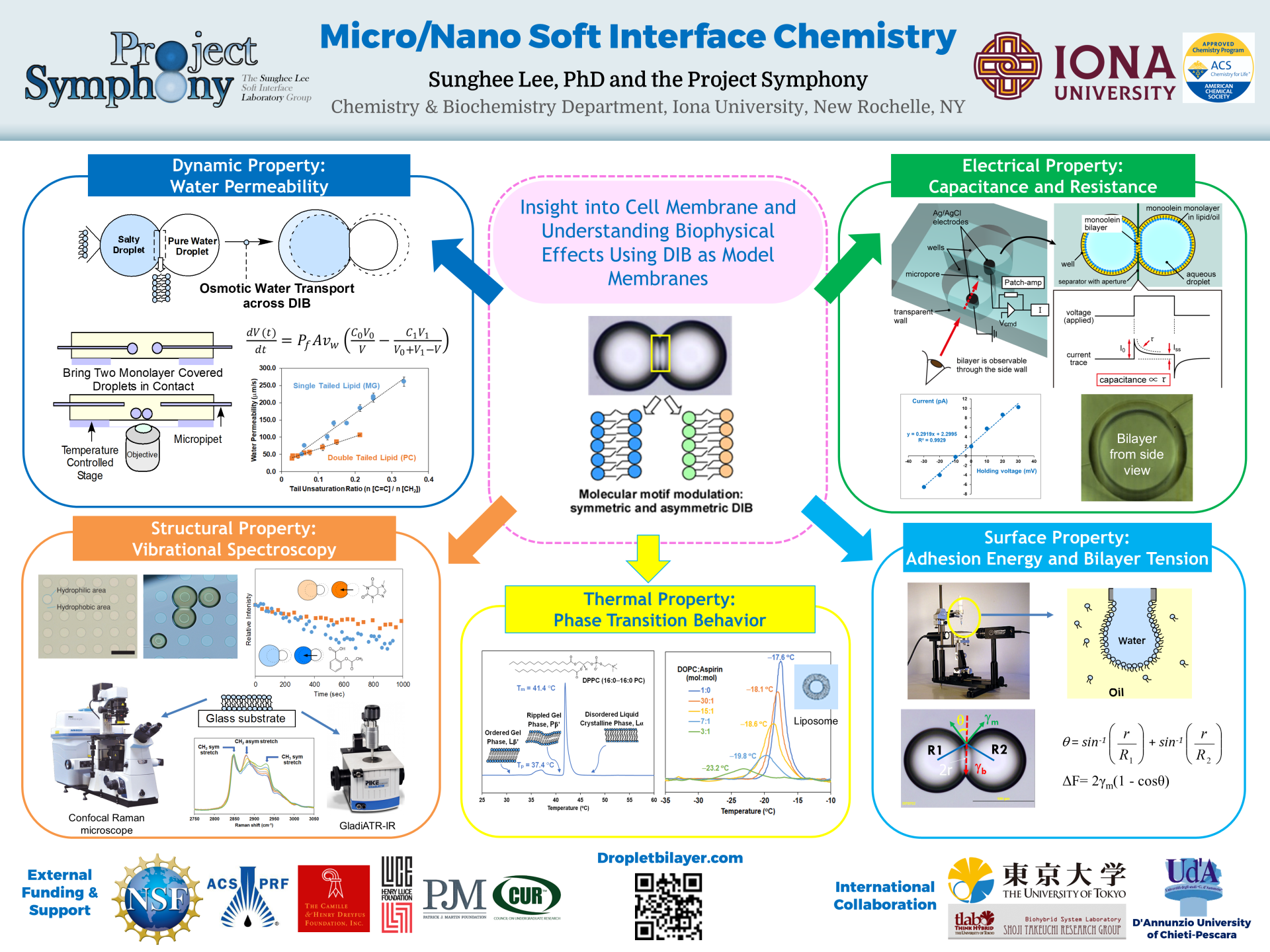
We would like to acknowledge our funding organizations which have enabled our active research program.